Showing posts with label WW II. Show all posts

Wednesday, April 1, 2020

It's a Pandemic. You'll Have To Change The Way You Do Things.

I don’t have to tell you we’re in the midst of a near-total shut-down, trying to save as many citizens as possible during an already deadly pandemic. People who aren’t sick yet are hurting, too, trying to maintain their lives, trying to stay safe. Workers are out of jobs and struggling to stay afloat. Businesses are suffering, many of them already in their death throes. They may not survive this. Our unemployment rates are pointing toward astronomical. This recession may turn into a full-blown depression. And the worst part: People are suffering and dying in numbers that grow exponentially, without signs of slowing. We’re all terrified, and I’m not making it better by reminding you of just how much.
But here’s the thing: We have a chance now to show the country who we are in a crisis. It’s our make-or-break moment and it’s up to each of us to rise to the challenge. We’ve done it before. This is all sounding familiar.
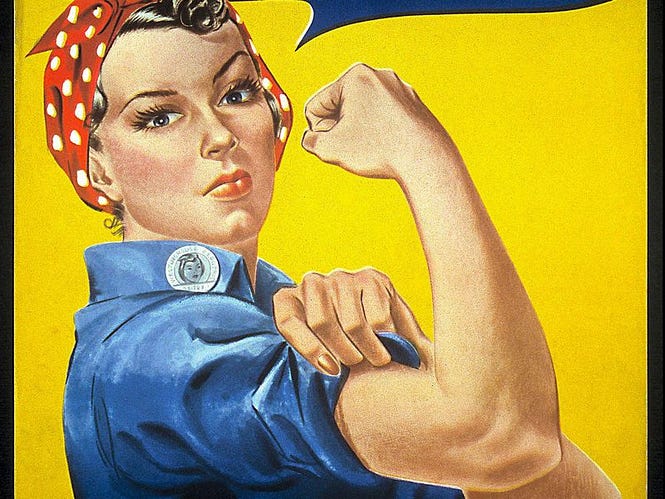
“We Can Do It” — National Museum of American History

I lived through rationing during World War II. I know — I was only a kid — but I remember things. I was in charge of collecting and cleaning bottles and tin cans. I peeled off labels, washed them, cut off the can bottoms, stuffed them inside the cans and stomped them flat. (That was the best part.) I bundled newspapers and cardboard and listened to my parents complain when there wasn’t enough coffee. (They were allowed one pound once a month for each of them. I didn’t count as a person yet.)
We kids brought our dimes to school and bought War Stamps and pasted them into books. My parents bought Victory bonds when they could.

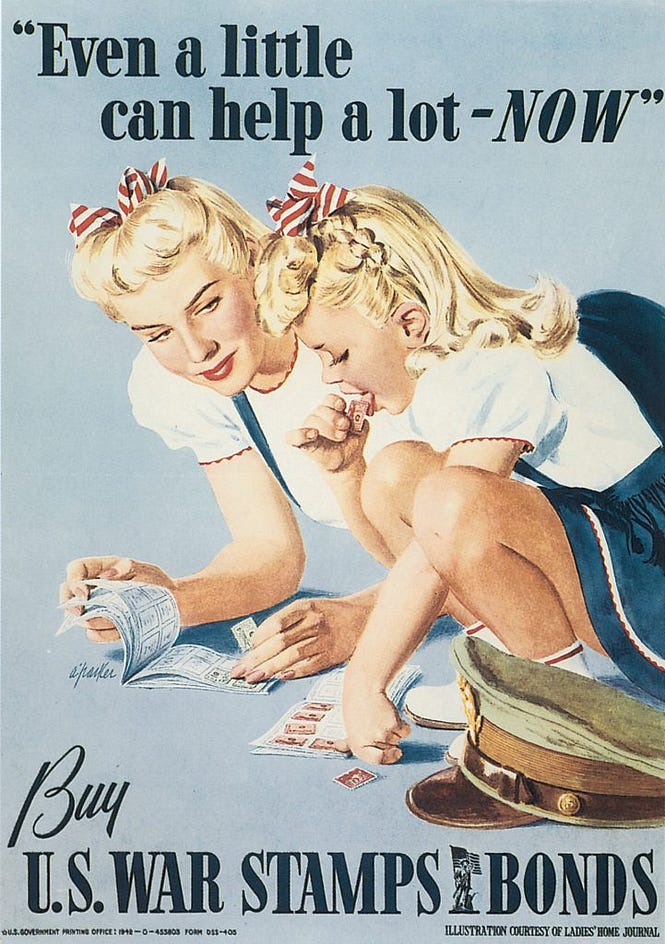
Wikimedia

The idea of rationing was to make sure everyone had just enough, but not too much. The problem with rationing — just as now — was that they never figured how to stop greed. We were warned against black marketeers almost as often as we were against ‘loose lips sinking ships’.
Hennepin County Library — with permission
Wikimedia Commons

We saved grease and took it to the butcher because it could be used for explosives. In some parts they collected garbage to feed hogs. People grew Victory Gardens and shared what they grew.

National Archives

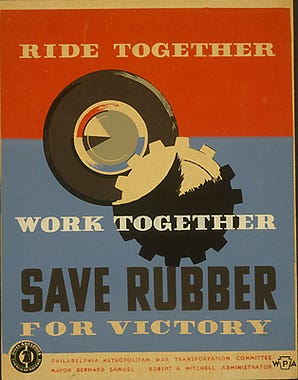
We stopped traveling when gas was rationed, and rubber tires were as valuable as gold. Our giddy idea of wealth was a spare tire and a patching kit. 

Library of Congress

When Nylon became a commodity used for parachutes, women took to wearing leg makeup and drawing fake seam lines down the backs of their legs. (Because working women were required to wear skirts and ‘hose’ at all times.)

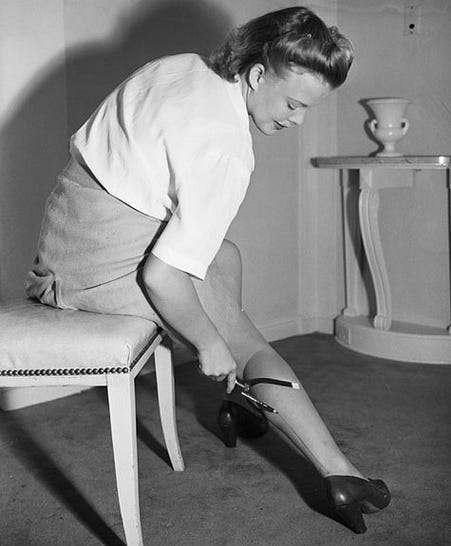
Source: Smithsonian
Poster source: Foundation for Economic Education

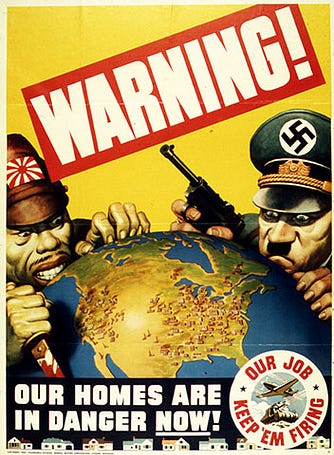
There were posters on walls and in magazines reminding us that our days of being wasteful were behind us. We had to be good citizens or Hitler and Tojo would win. And we didn’t want that, did we?

National Archives

Yes, much of it was propaganda meant to scare us, but it did the job: We were scared. It was our government at work, doing everything they could to keep the armies of the world safe and efficient against our common enemies, and, as good citizens, we were required to help.
Notice a pattern in these posters? It was all about shaming. It was all about being proud to be an American. You want to be a good citizen? Then do what you can to keep our boys alive. Let’s win this thing!
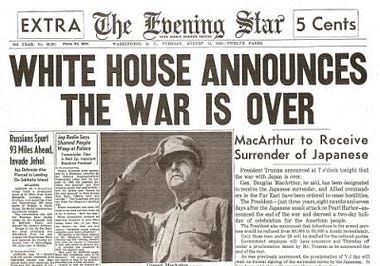
And we did. There is no question that too many Americans died in that war, but we did what we had to do to keep even more Americans from dying. And we felt good about it. That was key. We weren’t sitting on our hands waiting for something to happen, we were a force. We had it in us to make simple sacrifices that ultimately made the difference.

Wikimedia

So here we are again. We’re being asked to take stock and see what we can do to help. If it takes shaming, I’m all for it. If it takes constant reminders about what you can do for your country, remind me. Constantly.
But what if we could do this by just thinking about it and doing the right thing?
What if we didn’t hoard?
What if we didn’t gather in crowds?
What if we learned new ways of doing things?
What if we conserved food so others could eat, too?
What if we came together in hundreds of thousands of communities and looked out for each other?
And what if, when this is over, we kept it up?
Every life lost is a tragedy. Everyone is in danger. If we can do even a little to help the cause, we must do it. If we can do more, we must do more. We’re citizens of the world and the world is hurting. It really is up to us now.
(Cross-posted at Medium)

Monday, August 9, 2010

Shell Shock, Battle Fatigue, PTSD - A Human Heart is Crying Out

"As if there is not enough that has gone tragically wrong in this era of endless warfare, the military is facing an epidemic of suicides. In the year that ended Sept. 30, 2009, 160 active duty soldiers took their own lives — a record for the Army. The Marines set their own tragic record in 2009 with 52 suicides. And this past June, another record was set — 32 military suicides in just one month. War is a meat grinder for service members and their families. It grinds people up without mercy, killing them and inflicting the worst kinds of wounds imaginable, physical and psychological . . . [a]nd the multiple deployments (four, five and six tours in the war zones) have jacked up stress levels to the point where many just can’t take it. "  Bob Herbert, The Lunatic's Manual, NYT  August 2, 2010

I'm thinking now of three men I've known whose lives were changed dramatically by war.  Their injuries weren't as much to blood and bones and sinew as they were to the heart and mind.  They were each in their own way shell-shocked.


My Great-uncle Leonard, quiet and dignified even as a young man, I'm told, fought in the First World War.  He came back silent and withdrawn and by his own words, not fit for society.  He had lost so much weight people in his hometown didn't recognize him.  His sister-in-law told me he could be seen at all hours walking and walking and walking.  His beard grew long, his clothes grew tattered, and after a while people stopped seeing him altogether.
He told me later, when he was in his late 80s and still robust, that he had to go into the wilderness to heal himself.  He built a rude cabin deep in the woods and lived there for three or four years, coming into town only for provisions, getting out again, quickly, stealthily.

He spent his time hunting and fishing, following a daily regimen of grueling calisthenics to strengthen his body, and studying the habits of the deer and other wildlife living with him in the surrounding forest.  A simple life that no doubt also included a coming-to-terms with what he had seen and done on the battlefield.  Events which he never talked about, and would only describe some 60 years later as "terrible".

My grandmother's step-son sustained some leg injuries and was shell-shocked during World War II.  He walked with a wobble but his major wounds were psychic and so deeply embedded he never got over them.  He came back with a monthly government disability pension that usually lasted no more than a week.  Alcohol was his solace, and his barmates were his closest friends--until the money ran out.  He was called "Rubberlegs" by nearly everyone, including the kids.  When my grandmother heard us say it, she called us in and told us what had happened to him.  "They never should have taken him," she said. "They should have seen that Wesley's soul was too kind for war."

My cousin's Uncle Bill was a soldier in World War II, as were two of his older brothers.  I remember how handsome he was, looking to me just like Dennis Morgan, the movie star.  As a silly teenager I had an enormous crush on him and found any excuse to be near him.  After the war, he was staying with my aunt and uncle for a while, and one day I found him sitting alone in the living room.  He had his head down, his hands covering his brow and I thought he had drifted off to sleep.  Then I saw his shoulders shaking and realized he was crying.  I backed out and went to tell my aunt.  "It's the war," she said.  "It won't let him forget it."

His two brothers made the adjustment back to civilian life without any outward signs of trouble, even though they had both been in fierce battles on the European front, but Bill had been a medic at the Battle of the Bulge.  The images of bodies and body parts would not go away.  He was a lost soul for many years, drowning his memories in a sea of alcohol.

We train our children at an early age to be considerate of other peoples' bodies and feelings.  We do not hit.  We do not call names.  We do not cause deliberate harm to humans or animals.  And then we take those still malleable young people and send them to war, expecting them not just to forget societal rules but to completely turn those rules on their asses and do the exact opposite.

Once inside the base gates they're taught that there is honor in war, even though the ultimate goal is to kill.    We use fancy terms like "collateral damage" to define the innocents who get caught in the crossfire.   It takes a strong will or a dulled mind to pretend those innocents, young and old, are unworthy human beings.   It's enough to cause any conscious mind to crash.

A while back, George Carlin put his own take on the emotional casualties of war and the euphemisms we choose to slot them:
 There's a condition in combat. Most people know about it. It's when a fighting person's nervous system has been stressed to it's absolute peak and maximum. Can't take anymore input. The nervous system has either (click) snapped or is about to snap.
In the first world war, that condition was called Shell Shock. Simple, honest, direct language. Two syllables, Shell Shock. Almost sounds like the guns themselves. That was seventy years ago.

Then a whole generation went by and the second world war came along and very same combat condition was called Battle Fatigue. Four syllables now. Takes a little longer to say. Doesn't seem to hurt as much. Fatigue is a nicer word than shock. Shell Shock! Battle Fatigue.

Then we had the war in Korea, 1950. Madison avenue was riding high by that time, and the very same combat condition was called Operational Exhaustion. Hey, we're up to eight syllables now! And the humanity has been squeezed completely out of the phrase. It's totally sterile now. Operational exhaustion. Sounds like something that might happen to your car.

Then of course, came the war in Viet Nam, which has only been over for about sixteen or seventeen years, and thanks to the lies and deceits surrounding that war, I guess it's no surprise that the very same condition was called Post-Traumatic Stress Disorder. Still eight syllables, but we've added a hyphen! And the pain is completely buried under jargon. Post-Traumatic Stress Disorder.

I'll bet you if we'd of still been calling it Shell Shock, some of those Viet Nam veterans might have gotten the attention they needed at the time. I'll betcha. I'll betcha."

And I'll bet if we had a no-escape draft open to the sons and daughters of rich and poor alike, wars (if there were any) would be short and to the point.  Then we might not have to resort to euphemisms in order to get around the fact that as evolved human beings we're no longer built for war.

Ramona