Showing posts with label death. Show all posts

Monday, August 25, 2014

Five Years Later I miss Ted Kennedy Even More

May it be said of our Party in 1980 that we found our faith again.
And may it be said of us, both in dark passages and in bright days, in the words of Tennyson that my brothers quoted and loved, and that have special meaning for me now:
"I am a part of all that I have met
To [Tho] much is taken, much abides
That which we are, we are --
One equal temper of heroic hearts
Strong in will
To strive, to seek, to find, and not to yield."
For me, a few hours ago, this campaign came to an end.
For all those whose cares have been our concern, the work goes on, the cause endures, the hope still lives, and the dream shall never die.
Senator Edward Kennedy, August 12, 1980


 ________________________________________________________________________


Note:  Today marks the fifth anniversary of Ted Kennedy's death.  Here I repeat the post I wrote on the day we lost this great senator and friend to those who had almost given up on a government of, by and for the people.  I miss his huge voice, his huge heart, his ability to cut through the crap and get to the simple truths.  We could use you now, Teddy.  We could use you now.
__________________________

August 25, 2009:

I woke up this morning to the news I've been dreading for weeks now.  Ted Kennedy, the Good Man of the Senate, has died.  He has been on my mind a lot lately, as we wage this battle for the common good, because what I fear most now is that our progress will suffer badly without his counsel, without his presence.

For more than 40 years he has consistently been on the side of the people without power.  As former senator Bob Kerrey said on "Morning Joe" today, "If you're getting the shaft, you ought to be weeping today because Ted Kennedy was your best friend."

The list of his accomplishments, the bills he worked so tirelessly to get passed, the people whose personal stories tell the tale of a man of high privilege coming to understand his role in the negation of human misery--are all part of our history we will never forget.

But no matter how much we would prefer to concentrate on the triumphs of his life, on the undeniable good he has done for his country, the specter of Chappaquiddick will never stop casting a long shadow over it all.

Already, this early in the morning, it comes up in the remembrances of those who knew him and are now before the cameras talking about his life.  It happened--we know it happened.  The facts are that Mary Jo Kopechne's life ended on July 18, 1969, after  drowning in a river on Chappaquiddick Island.  It was late at night and she was a passenger in a car driven by Sen. Edward Kennedy.  They were heading toward the ferry to the mainland after a victory party when the car skidded off a bridge and crashed into the water. Kennedy survived, but Mary Jo didn't. She was just days away from her 29th birthday.

There is no question that Ted Kennedy panicked and swam across to the mainland, leaving Mary Jo in that car in that river.  Did he try to save her?  He says he did.  He says he was going for help, but it was hours before anyone found the car with Mary Jo's body inside.

Leaving the scene of an accident is a crime, and there were a lot of us--maybe most of us--who wanted to see him, at the very least, serve time in jail.  His sentence was eventually suspended, a seemingly contemptuous judicial act that stunned us all.  No punishment for running like a coward, allowing a young woman to die?  Why?  Because the rich and famous are exempt from having to pay for their sins?

For years I didn't want to ever hear the name Ted Kennedy again.  For years I heard the stories of his drinking, his carousing, and I wondered how the good people of Massachusetts could go on electing him.

He ran for president against Jimmy Carter and campaigned badly.  Again, we counted him out.  Then he gave his concession speech, his "the dream shall never die" speech, on the night of Jimmy Carter's primary victory.  There were a number of us in the room that night watching the returns, but I can still remember how quiet it was as we listened to the final moments of his speech..  I remember that none of us expected much from him by that time so when he started we were barely listening.  When it ended, we all looked at one another and someone said, "Why in God's name did he have to wait until now to give that speech?"

I've heard people say that he campaigned badly because, after Chappaquiddick, he felt deep down that he didn't deserve the presidency.  I can't begin to look into Ted Kennedy's soul at the time, but after that defeat he was a different man.  He went to work to fight for the causes his liberal heart told him were the most important, and he never looked back.
 
Already I'm seeing the hatred toward the Liberal Lion, the greatest senator of our times, bombarding the boards.  I won't repeat them here because I choose to celebrate Ted Kennedy's life.  It's a life that is ultimately deserving of praise.  Many of the people who are without a doubt going to go on the Hate Kennedy rampage today will laugh at the idea of a plea for forgiveness,  so I'll say this in words that most of them can understand:

Luke 17:3 - Take heed to yourselves; if your brother sins, rebuke him, and if he repents, forgive him.

To forgive is not to forget.  I'm not alone in wondering where Mary Jo's life would have taken her.  From all accounts, she was good, decent, smart, loving.  She was on Robert Kennedy's staff, even helping to write a speech he gave against the Vietnam War.  Who knows what kind of career she would have chosen?  Where she would be today?

I've always wondered if it's possible that Ted Kennedy chose to give his life over to helping people who couldn't help themselves because the one time he might have actually saved a life, he failed.  A noble act of repentance.

If I weep for Ted Kennedy today, it is not for all the things that might have been, it is for all the things that were and now will be no more.

Ramona

Wednesday, February 19, 2014

The Story: Pentecostal Snake Handler refuses help and dies. My Reaction: Surprising, even to Me

For days now, since I heard about the death of Jamie Coots, the snake-handling preacher from Middlesboro, Kentucky, I've been struggling with my own thoughts about it.  There is no reason in the world why I should be involved in any of it.  I didn't know him.  I had never before heard of his church.  And I didn't know before this weekend, when I read about his death, that he had been the star of a National Geographic Channel series called "Snake Salvation".

Photo:  National Geographic
 I read about his death--about how he had been bitten by a venomous snake during a church service on Saturday, about how his family carried his unconscious body to their home, about how the family refused help from the EMS team dispatched to their home with the needed anti-venom serum, about how Jamie Coots of the Full Gospel Tabernacle in Jesus Name died without ever waking up again--and before I had even finished reading the article a blog post was already taking shape.

The more I read about this man, about his beliefs, about the origins of Pentecostal snake-handling in the hills of Appalachia, the closer I came to seeing it as a story ripe for ridicule.  And I wrote it that way.  I had some funny lines in there--laugh-out-loud, if I do say--and I had a link to a video that would make Jamie Coots look foolish.  He did look foolish.  To me.  But I couldn't get it right.  I kept coming back to the raw fact that a man had died.  A man was dead and I was trying to create a piece that would be a candidate for Wacky Story of the Week.

It isn't that.  It's a story about belief and trust and how difficult it sometimes is to understand interpretations, perceptions and faith.

It's about the actions of generations of men who invented and relied on their own definitions of a few passages of the bible having to do with the handling of snakes in order to start a new kind of church.

And it's about us, the outsiders, and where we draw the line.

For any church, for any religion, the outsiders are irrelevant. Unless we're directly affected, their methods of worship are their business, not ours. If we don't understand their rituals, they can live with that.

My own sense is that we draw the line when it's evident that during their rituals people can be, and have been, physically harmed.  Then we step in and look around.  In this case, it should be easy to analyze the problem here:  Their religion causes them to show their devotion to God by handling venomous snakes.  As reported in a USA Today article, they don't believe that God will save them from snakebites.  That's not the point:
Professors who study snake handling say worshipers are very aware of the risks they are taking and accept the consequences.

Brian Pennington, a religion professor at Maryville College in Maryville, Tenn., has studied Coots during his research on snake handling in worship.

He said the prominent leader of the snake handling community saw the practice as "an absolute command of God."

"These are not irrational people. These are people who know very well what they're doing every Sunday or Wednesday night — whenever it might be they go into that church," Pennington said. "They know very well the fate that Pastor Coots suffered could be suffered by any of them who does this during a service."
 Throughout the history of the Pentecostal snake-handling movement, mainly based in rural Appalachia, many people have died from snake bites, including the movement's founder, George Hensley.  After being bitten numerous times, one of the bites finally killed him.  He wasn't alone.  There are no accurate records of the numbers of snake bite deaths during these rituals, but it was enough for some states to outlaw religious snake handling.

In 2012,  Mark Wolford, pastor at the Apostolic House of the Lord Jesus, died of snake bite wounds.  These deaths aren't nearly as publicized as that of Coots, who was the star of a TV show and thus better known, but they happen, and are expected to happen.
"A common misunderstanding is that handlers believe they can't get bit or it won't kill them," [Ralph Hood, a religion professor at the University of Tennessee at Chattanooga] added. "What they'll tell you is, `No one will get out of this alive.' They'll also tell you it's not a question of how you live; it's a question of how you die. ... This is how he would have wanted to die."
  The problem, then, and the reason we pay attention--beyond a natural curiosity about something as odd as serpent-handling for God--is that people seem to be willing to die for reasons we will never understand.  They are deliberately putting their lives in jeopardy as a supposed honor to God.  All based on a few slim passages nearly hidden away in the King James version of the bible.

I was angry when I first heard about this--and maybe I still am.  People are dying over something that makes no sense.  But the longer I got into it, the more I came to realize--for my own self--that we can't help them.  We can't understand them and we can't help them. They embrace a literal translation of a few biblical passages and have created an entire religion around it.  A religion that's over a century old now.  That's pretty monumental.  In the end, it doesn't have to make sense to anyone else. 

There is the snake's point of view, of course, and it shouldn't be ignored.  Some say that in order to keep the snakes willing and docile, they underfeed and underwater them.  They keep them tightly together in glass cages and their life span--three to five months--is far below the normal span of 10 to 20 years.  That is animal cruelty and needs to be addressed.

But if it can be proven that no snakes are harmed in the process, I'm all for moving on to something else.  They're going to do what they're going to do with or without our blessing--which, it should be noted, they haven't asked for.

Even now, the next generation is moving to take over where Jamie Coots left off.  Jamie's son, Cody, will follow the family tradition. (Jamie's father and grandfather were both serpent-handling preachers)  Children in these churches are not allowed to handle snakes, but nobody stops them from watching.  If they're brought up in a culture where handling venomous snakes is a major part of honoring their God, it would be the rare kid who wouldn't want to try it as soon as they came of age.  Even the dying part is noble.  But once they're adults, our commitment to watch over them has ended.

According to Knoxville's WATETV. com on Sunday:
 The pastor's son [Cody ]Coots saw the snake bite his father last night.

"The snake that bit him, we've been carrying it for four months. It's been carried hundreds of times and handled all kinds of times. But when it's your time to go, it's just your time to go," Cody Coots said.

Cody says while they're in shock, his family will stand strong in their beliefs.

"I don't think it's dangerous. It's the word of God. We've always said it's a good way to live by and it's a good way to die by," Cody Coots said.

Cody Coots is expected to keep his father's ministry going.

Tuesday, January 28, 2014

Farewell, Pete Seeger. Peace Be With You.

I woke up this morning to the sad news that Pete Seeger, America's folk singer and man of peace, has died.

He was 94 years old, so we should be grateful that we had him with us for so long.  He was a man whose presence was timeless and inspiring, and the truth is, we needed him.  We need him still.

He was more than a singer/songwriter, although in his case that would have been enough.  He was a man of courage, unafraid to face down fancy fools and demagogues.   In the 1950s he was hauled before Joe McCarthy's Red-scare witch-hunters and branded a communist--a brand he neither confirmed nor denied until much later, when he said he had been a communist for a time but dropped out.  He never failed to remind those who asked that it was never illegal in this country to be a communist.  The young ones were, as you might imagine, surprised to hear it.

He was jailed, blacklisted, and was sentenced to 10 years for contempt of Congress. (That last one was overturned, but he was able to retain the bragging rights.)
During the communist witch-hunts of the early Fifties, however, the Weavers were blacklisted, resulting in canceled concert dates and the loss of their recording contract with Decca Records. Under congressional subpoena to testify before the House Un-American Activities Committee, Seeger asserted his First Amendment rights, scolding the committee, “I am not going to answer any questions as to my associations, my philosophical or my religious beliefs, or how I voted in any election or any of these private affairs. I think these are very improper questions for any American to be asked.” - See more at: http://rockhall.com/inductees/pete-seeger/bio/#sthash.Tltp8l5j.dpuf
 In 1955, Seeger was subpoenaed to testify in front of the House Committee on Un-American Activities. He was famously uncooperative, citing the First Amendment (freedom of speech and association) instead of the Fifth (freedom from self-incrimination) when he refused to answer, because he believed there was nothing "incriminating" about knowing communists or being one. Clubs and TV shows canceled the Weavers' bookings, their recording company voided their contract, and their records vanished from stores and radio airplay. Seeger was indicted for contempt of Congress, and sentenced to ten concurrent one-year terms in prison (a sentence he didn't serve, as it was overturned on appeal). Seeger and his band were blacklisted, and for years worked only in tiny clubs willing to take the risk of hiring them.
Pete never failed to let us know he was one of us.  His concerts became one big sing-along, where everyone joined in and became his back-up singers.  (That could be because Pete himself said as a singer he made a pretty good song-writer, but his audiences loved it.)

We knew the words to his songs by heart and understood where the words came from.   He cared about the least of us.  He was a union man.  He was a man of peace who would not submit.

Solidarity forever, Mr. Seeger.  It was a privilege to be on this planet with you.  You will live on.  We'll make sure of that.

Tuesday, August 20, 2013

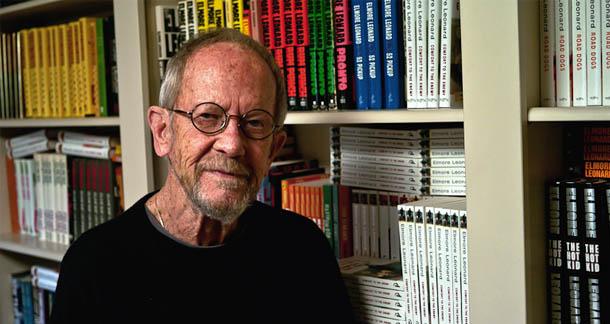
RIP Elmore Leonard

Sadly, Elmore Leonard, has died.  He was Detroit's foremost novelist and cheerleader.  I wrote about him at Constant Commoner today in a piece called "I called Elmore Leonard 'Dutch' Once".

You can find it here.


Tuesday, April 9, 2013

Back in Michigan but not quite home

Just to let you know I haven't fallen off the face of the earth. We've been living out of suitcases for almost two weeks now as we worked our way north from our winter digs.  We're in the U.P finally, on the last leg home.  Should get there today and I'm hearing bad news about a snow mound that still needs digging out before we can get to our door.  Should be interesting.

Our nephew plowed out our driveway but put his back out before he could shovel the walk.  Don't know what we're going to do with him but rest assured he'll be punished for this.

Our house in winter


But the worst of it is that my brother Mike died suddenly of a heart attack on March 21.  He was 66 years old. My brother Chris and I are his only next-of-kin and we've been trying to do what we need to do to put his soul to rest and to clear up his affairs.  Someday I may write about him but for now it's too soon.

Life will settle down soon, I hope, and then I'll be back to doing what I love to do best:  Antagonizing the hell out of myself and others.

Mona